Showing posts with label pottery. Show all posts

Sunday, November 4, 2012

Changing Kiln Elements

Jo changed the elements in her kiln.  She did the majority of the job herself, but needed my help crimping the wires from the controller onto the elements.  That job requires brute force, a strong grip to get the metal sleeve connectors crimped securely.


Kiln sitting in messy kiln room.  Ready to have controller wires connected to new elements.


There are six elements.  Both ends of each element must be connected to the controller.  This is accomplished with a jumper wire.


Detail of element pigtail sticking out of the kiln.  An old connector is still on the end of the wire.  It must be cut off and a new sleeve crimped into place.  Then, the wires are crimped onto the pigtail.  The controller wire is stranded, but the element pigtail is two pieces of solid wire twisted together.  This make crimping securely more difficult.


All element wires are connected.  The piece of yellow wire that is still dangling connects the the kiln's pyrometer.

Jo flanged up the job Saturday afternoon.  She's test firing today.


Share/Bookmark

Wednesday, December 29, 2010

Pottery Hands


Pottery Hands: Touching clay spinning on a potter's wheel for the first time.

(Art in the Park, Columbia, MO)

.
Share/Bookmark

Monday, December 20, 2010

Moving Jo's Glazes to the Basement


Moving buckets of glazes from Jo's studio to the basement so they won't freeze during and extended period of below freezing temperatures. After freezing, glazes must be restirred and strained. Preventing them from freezing is a lot less work.

.
Share/Bookmark

Wednesday, October 7, 2009

Setting Up Jo's Booth In St. Louis


Jo does an excellent job of setting up her booth -- and with very little supervision. Actually, I helped erect the canopy, unloaded the shelving and will help with other tasks when Jo's finished with the shelving. The shelves will hold her pottery and must be set up and leveled to her satisfaction. It's best if I just stay out of the way and let her get the shelves set up the way she wants them.

----------

Tuesday, 10/6/09:

Rain off and on all day -- mostly just drizzle and light rain, no downpours or thunderstorms in our area. A total of a little more than a half inch of rain. The rain finally stopped and our skies began clearing during the late evening. Wednesday is forecast to be sunny. However, by Thursday this weak cool front is supposed to turn around and return as a warm front, bringing a couple of days of rain back into our area. Loading on Thursday and leaving on Friday is liable to be messy. High = 68°F/20°C. Low = 55°F/13°C.


.
Share/Bookmark

Thursday, September 17, 2009

Groundhog Kiln Firing #5


John and Jo are preparing to start the warming fires in the three air intake ports at the front of the kiln. John appears momentarily distracted by an interesting newspaper article.


Kai does the honors of lighting the first fire.


Jo takes her turn at fire lighting.


John helps the fire along.


Once the fires in the air intake ports are going, John bricks up the kiln door.


After the fires in the air intake ports have warmed the kiln and built up a few coals, we'll start adding wood to the firebox which is right behind them.


While the cones ultimately determine the progress of the firing, a pyrometer is useful for getting a quick look at what's going on inside the kiln. We had pyrometers taking temperature reading at various locations in the kiln.  This is the temperature not long after the fires were started around 11:00 AM on Saturday.


Creative Commons License
This work is licensed under a Creative Commons Attribution-Noncommercial-Share Alike 3.0 United States License.
.
Share/Bookmark

Wednesday, September 16, 2009

Groundhog Kiln Firing #4


Judi Munn inside the kiln adding a few more pots to the kiln load. Judi is actually in the kiln firebox. Below her is a metal grate with a couple of boards laid on top. Marvel, one of the other potters participating in this firing, looks on.


Judi climbing out of the kiln. A BEFORE shot of Judi. See here for a photo of Judi AFTER the firing is completed.


A shot of the kiln showing one of the stoking ports. There is a stoking port above the firebox on both sides of the kiln.

During the firing, stoking alternates from side to side. One stoker adds wood, then when the stoker on the other side hears the opposite stoking door close, he/she opens the door on his/her side and also adds wood. Stoking alternates from side to side for safety. A hefty toss could send (has sent) wood straight through the firebox and out the opposite stoking door if both were open at the same time. Throwing wood at your fellow stoker is frowned upon in polite kiln-firing circles, especially considering that after the firing is going good, the wood will ignite on its way through the kiln.

One of the things that's always amazed me about the construction of all conventional wood and gas fired kilns is that they are made with dry stacked brinks. No mortar could hold up to all the expansion and contraction that occurs. Angle iron at the corners and a system of chain and turnbuckles binds the kiln together. The roof is constructed the same way kiln roofs have been for a few thousand years. It is an arch. During construction bricks are stacked on top of a wooden form. Once the keystones are in place, the form is removed and gravity holds everything together.


A view of the pots inside the kiln taken through one of the stoking ports. During the firing wood momentarily rested on the bricks surrounding the port while getting a better grip for tossing will ignite. The stoker is standing only a couple of feet away from this very hot brick. It's hot work.


The last pot is finally loaded and John is building the bag wall. The bag wall reduces the amount of flame from the firebox that goes straight back onto the pots in front of the kiln. 


The completed bag wall. We're finally ready to fire up the kiln.


A larger version of all photos is available by clicking on the photo.


Creative Commons License
.

Share/Bookmark

Monday, September 14, 2009

Groundhog Kiln Firing #3


The kiln shed at the Ozark Folk Center State Part in Mountain View, Arkansas.  I was thankful the kiln is under a shed as numerous thunderstorms passed over Friday evening while the firing was in progress.  Off and on drizzle continued Saturday morning.  Of course, the shed also protects the kiln from the elements during the rest of the year when it is not in use.


Judi Munn, John Perry and their son, Kai.  Judi and John are the potters at the Ozark Folk Center.  Judi is putting the waddings on the bottom of a pot.


A kiln load of glazed pots ready for firing.  One of the downsides of such a large kiln is test firings are not possible.  The potters work for weeks throwing pots, bisque firing and glazing.  If something goes wrong with the firing or if there is something wrong with the clay body or glazes, all that work goes down the tubes at one time.  Judi and John lost an entire kiln load of pots during an earlier firing.  The clay they used was contaminated causing it to bubble and blister during the firing, a heartbreaking discovery to find when opening the kiln up after a firing.


A close up of some of the pots in this kiln load, including three of Jo's funky bud vases.  Jo brought several of her bud vases to the firing because she knew they'd be easy to work into place amongst the rest of the pots.  John and Judi had the kiln mostly filled with their work before the other potters arrived.  This prevented a last-minute rush and chaos while completing the loading.

Note that most of the pots only have glaze applied to their rims and none are glazed all the way down to the base.  The front is the hottest part of the kiln.  Were a fully glazed pot fired in this area, most of the glaze would melt and drip off onto the kiln shelf.  During the firing, these pots will be glazed with molten wood ash.


The front cone pack.  Pyrometric cones are pyrometric devices that are used to gauge heatwork during the firing of ceramic materials. The cones are positioned in a kiln with the wares to be fired and provide a visual indication of when the wares have reached a required state of maturity, a combination of time and temperature. Thus, pyrometric cones give a temperature equivalent, they are not simple temperature-measuring devices.

The pyrometric cone is a pyramid with a triangular base and of a defined shape and size; the "cone" is shaped from a carefully proportioned and uniformly mixed batch of ceramic materials so that when it is heated under stated conditions, it will bend due to softening, the tip of the cone becoming level with the base at a definitive temperature.  (Wikipedia)

A cone pack for firing a smaller kiln usually contains three cones:  The cone you intend to reach and one step below and above.  The temperatures within this large kiln varied (hotter in front, cooler in back), hence more cones in the cone pack.  As Jo remembers it, the front of the kiln reached Cone 13 while the back only got up to Cone 8 -- more are less.  (Cone temperature conversion chart)  Because this front cone pack is in the very hottest part of the kiln, it's useless for judging the maturity of the kiln load.  It functions more as an early warning system letting you know when to start paying more attention to the cones place in several locations elsewhere in the kiln.

During the firing, the cone packs are viewed through peepholes (removable bricks).  After the firing gets going good, you must view the cones through a welder's-type filter lens.  For one thing, everything is glowing white hot and the cones are difficult to see without the lens.  More importantly, without the lens eye damage is possible.


Creative Commons License

.
Share/Bookmark

Saturday, September 12, 2009

Groundhog Kiln Firing #2

Jo and I recently participated in firing the Groundhog Kiln over at the Ozark Folk Center State Park in Mountain View, AR. The kiln was built in 2002 and is similar to the kilns used in the South in the 1800s and early 1900s when pottery jugs and crocks were the containers used for storing most liquid items. John Perry and Judi Munn are the potters at the Ozark Folk Center. (Click on photos for larger view.)


White glue is applied to the bottom of the pot. It holds the wadding in place prior to the firing.


Jo presses the wadding into the white glue on the bottom of the pot. Wadding is a porous and pliable clay mixture that forms "feet" for the pots during the firing.


All three wadding "feet" applied to the bottom of the pot. Without the wadding, the wood ash would fuse the pot to the kiln shelf during the firings. Waddings are easily removed after the firing.


Part of the wood used during the firing. It is scrap from the local handle mill. We ended up not having enough wood on hand forcing John to scramble for more wood during the early morning hours. (John and Judi's glazed pots that would not fit into the kiln for this firing are in the background.)


Jo is leveling a bowl after applying its wadding feet.


Creative Commons License
This work is licensed under a Creative Commons Attribution-Noncommercial-Share Alike 3.0 United States License.

.

Share/Bookmark

Friday, September 11, 2009

Groundhog Kiln Firing #1

Jo and I recently participated in firing the Groundhog Kiln over at the Ozark Folk Center State Park in Mountain View, AR. The kiln was built in 2002 and is similar to the kilns used in the South in the 1800s and early 1900s when pottery jugs and crocks were the containers used for storing most liquid items. John Perry and Judi Munn are the potters at the Ozark Folk Center. (Click on photos for larger view.)


Sign describing the kiln, its history and the firing process.


Jo brought over a few pots to including in the firing. The first step was getting them glaze. The glaze had been sitting for a while and needed stirred. She's pouring the glaze through a sieve to help break apart the solids that coalesced into globs.


Jo, Burt and Judi glazing having too much fun glazing pots. Judi is "on duty" at the Folk Center and required to wear traditional dress. Burt is another potter participating in this firing.


Jo and Burt are trying a different glaze.


Jo's pots are glazed and ready for the next step.


.
Share/Bookmark

Thursday, March 12, 2009

Kiln: Glaze Firing


Jo's kiln reached it's temperature for this glaze firing, a little over 2300º F.  She has the controller set to "fire down" slowly -- as opposed to simply shutting the kiln off and letting the temperature drop.

.
Share/Bookmark

Tuesday, October 14, 2008

Journal: Tuesday, 10/14/08

Morning:

Woke up to overcast skies and a very light drizzle. We received a light rain shower around ten o'clock -- maybe .1" of rain.

Noon:

Skies have cleared to mostly cloudy and the sun is breaking through occasionally. Temperature is up to 76º.


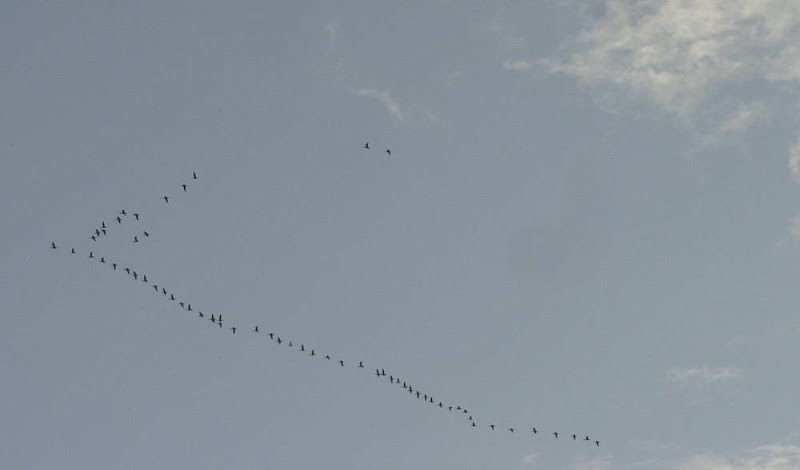
Not that you can really tell much from this distance with our camera, but the geese are heading south. There may have been others, but this is the first flight I've seen this fall.


Spent the morning on the computer updating my journal posts to include the past weekend at Art in the Park in Springfield, MO.


Afternoon:


Unloaded most everything out of the van for the first time in four weeks. The shelving boards and canopy frame are the only items remaining inside.


Jo is back to work building up inventory. She says she's teaching herself how to throw pots again. She had very little time to work on pottery between shows. What little time she had was devoted to either bisque firing pots already thrown or glazing and firing pots already bisqued. Jo hasn't actually thrown a pot in a little over a month.


We walked to the gate an back. While in Springfield, we walked ever day, but walking on flat land is not the same as hiking in our hills. A little more fall color is beginning to show, though you cannot tell we are well into fall by the temperature, which made it up to 77º today.


Skies continued alternating between partly and mostly cloudy. At day's end, partly cloudy appears to be winning, though there's a high chance of rain in tomorrow's forecast.


Evening:


Heard from a friend of ours concerning the medical condition of her little Yorkie. Marsha Becker-Kyle was set up next to Jo and I at the Art in the Park show in Springfield, MO. During most of the show, her two little Yorkies (Baby and Roxy) stayed in her van, but she had them out Sunday afternoon. To make a long story short, Roxy fell of a plastic tote. She yelped quite a bit at the time and wouldn't put any weight on the leg for the rest of the afternoon. Marsha took Roxy to the vet on Monday. One of her front legs was dislocated at the shoulder. After being anesthetized, Roxy's leg was popped back into place. Her leg is sore, but she's doing okay. Marsha and her husband Jay will be in Arkansas Wednesday setting up for the Bella Vista Art Fair. The girls will be boarded at the vet's this time around.


Share/Bookmark

Friday, October 10, 2008

Journal: Friday, 10/10/08

Up at 6 AM, morning routine, finish loading Scotty, etc.  Pull away from the house on our trip to Springfield a little after eight o'clock.

First stop:  Searcy County Courthouse.  We'd forgotten our county property taxes when Jo went into town on Wednesday.  They are due today.  We had to get our taxes paid before leaving town for the weekend.  Didn't take long.

Second stop:  Wally World in Harrison.  A couple of items bought, but mainly needed to stretch our legs and use their facilities.  A rest area is just a few miles up the road, but it's on the wrong side.  It's sometimes very difficult to get a break in the traffic so one can pull back onto Highway 65 heading toward Springfield.

Got to Ozark Highlands Mobile Home Park a little before noon. (135 miles) The mobile home park has around 300 spaces for mobile homes.  When we first started using Ozark Highlands, all these spaces were used by permanent residents.  There was a gravel lot with hook ups in the back of the park for three dozen or so RVs.  Many of the RV slots were always taken by long-term occupants -- construction workers and the like.

In recent years, more and more long-term occupants are assigned spaces amongst the permanent residents.  I supposed the demand for mobile home spaces has fallen over the years as it became easier to finance a non-mobile home.  Now there are always plenty of spaces available in the RV lot whereas in the past, reservations made well ahead of time were necessary.

Jo and I got the Scotty situated in its RV slot, which doesn't take long, and had a sandwich for lunch.  I tried to catch a quick nap, but Rusty and Bucket went off on a barking session about the time I fell asleep, so that was the end of my nap. We drove on down to Sequiota Park to set up for the Art in the Park show.  The show site is only about three miles from the RV park.

Since we had only one booth to set up and most of the afternoon in which to accomplish that task, we didn't get in any big rush.  We piddled at setting up the booth and stopped to visit with several new arrivals as they pulled into the park.  By seven o'clock we had the booth set up.  Since there was no bad weather in the forecast, Jo even put her pots out on the shelves.  (She doesn't usually do that until Saturday morning.)  We headed back to the trailer for the remainder of the evening.

.

Share/Bookmark